
The Lobster Place — Wholesale
Content and website strategy for a wholesale seafood business
The Lobster Place has supplied seafood to New York restaurants, caterers, and chefs since 1974—a Chelsea Market counter that draws visitors from around the world, and a wholesale operation run out of a Bronx warehouse for some of the city’s most demanding kitchens. When their team took on a redesign of the restaurant and retail sites, they asked us to take a fresh look at their wholesale site.
LOCATIONNew York, NY
PROJECT SCOPEResearch + Discovery
Strategy Workshop
User Personas
Competitive Review
Website Strategy + Recommendations
Site Map + Requirements
Mobile + Desktop Wireframes
Copywriting
Developer Coordination
COLLABORATORS Onethread design (design)
Zack Lerner (development)
THE OPPORTUNITYA site built for browsers, used by professionals
The retail and restaurant sides of The Lobster Place exist to be discovered. Wholesale doesn’t. Its users know seafood and arrive with a job to do. But all three businesses shared one website, so wholesale was built like the others: a family history up top, a Shop Online button meant for retail shoppers, and the sales line tucked into the footer. Almost everything about it could be improved by starting from the actual user.
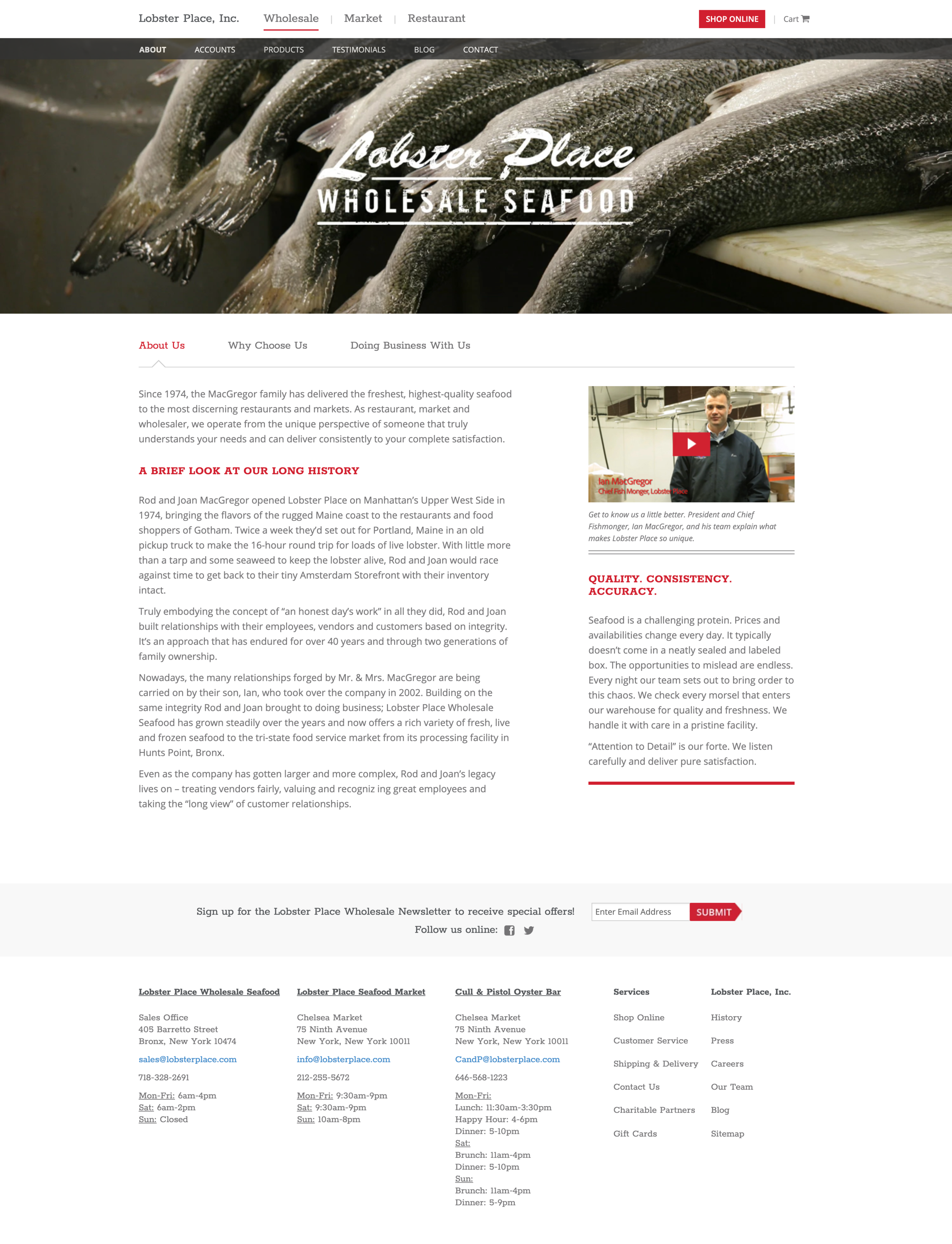
Before: one site for three very different businesses.
THE CHALLENGEChefs aren’t looking for inspiration — they’re looking for information
The people using this site are time-pressed and experienced. They want to know what’s in season, what’s available today, how to order, and when it arrives. Anything sitting between them and those four answers is friction, and friction with a professional buyer is expensive.
And the person most likely to land on the site usually isn’t a loyal customer. Loyal customers email or call in their orders, some with the item codes memorized. It’s a chef or buyer who’s unhappy with their current supplier and looking for a new one. Switching suppliers is a real hassle in this industry, so the site’s main job was to make that switch feel easy. It also had to make clear, fast, that a company called The Lobster Place sells a lot more than lobster.
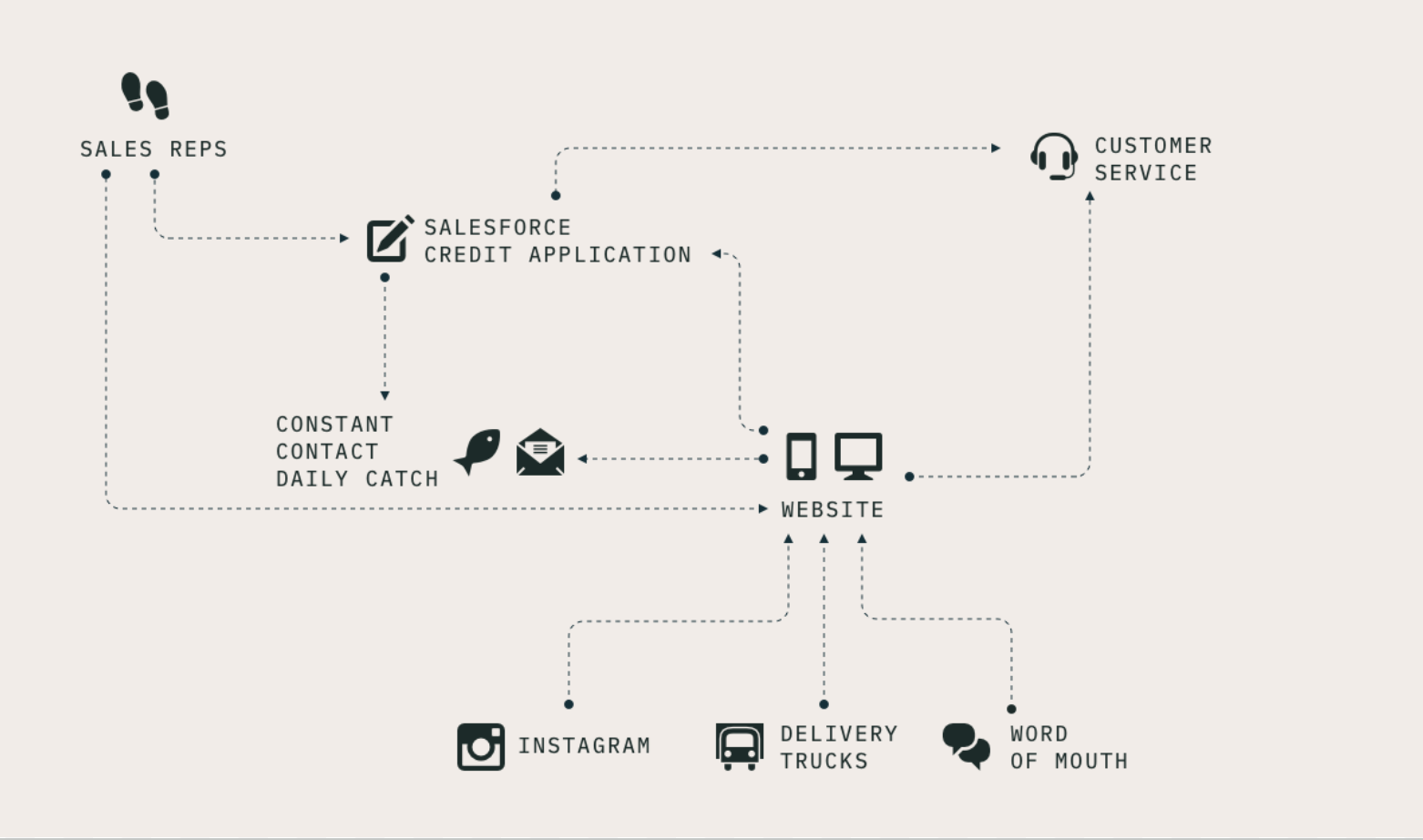
Our diagram shows how customers find the site and where it hands them off: to the credit application, the newsletter, or a person on the phone.
THE PROCESSA strategy workshop, then a hard look at the category
Before we got everyone in a room, we sent the team an intake questionnaire covering their product list, the kinds of accounts they sell to, their sales materials, internal systems, and day-to-day workflow. We also read through their existing web copy and emails, and the transcripts of their customer interviews. Buyers told us they order by email or phone, appreciate the acknowledgment that comes back, and care most that the delivery shows up on time and as ordered.
Their answers set the agenda for a half-day workshop with the CEO, the president of retail and restaurant, the wholesale marketing manager, and the site designer from Onethread. We started with what the site was for and who actually uses it, then built four user personas and mapped what each one needed to get done. From there we brainstormed content in three columns (what meets user needs, what communicates the brand, what helps with search) and finished by deciding what a chef should see first on a phone.
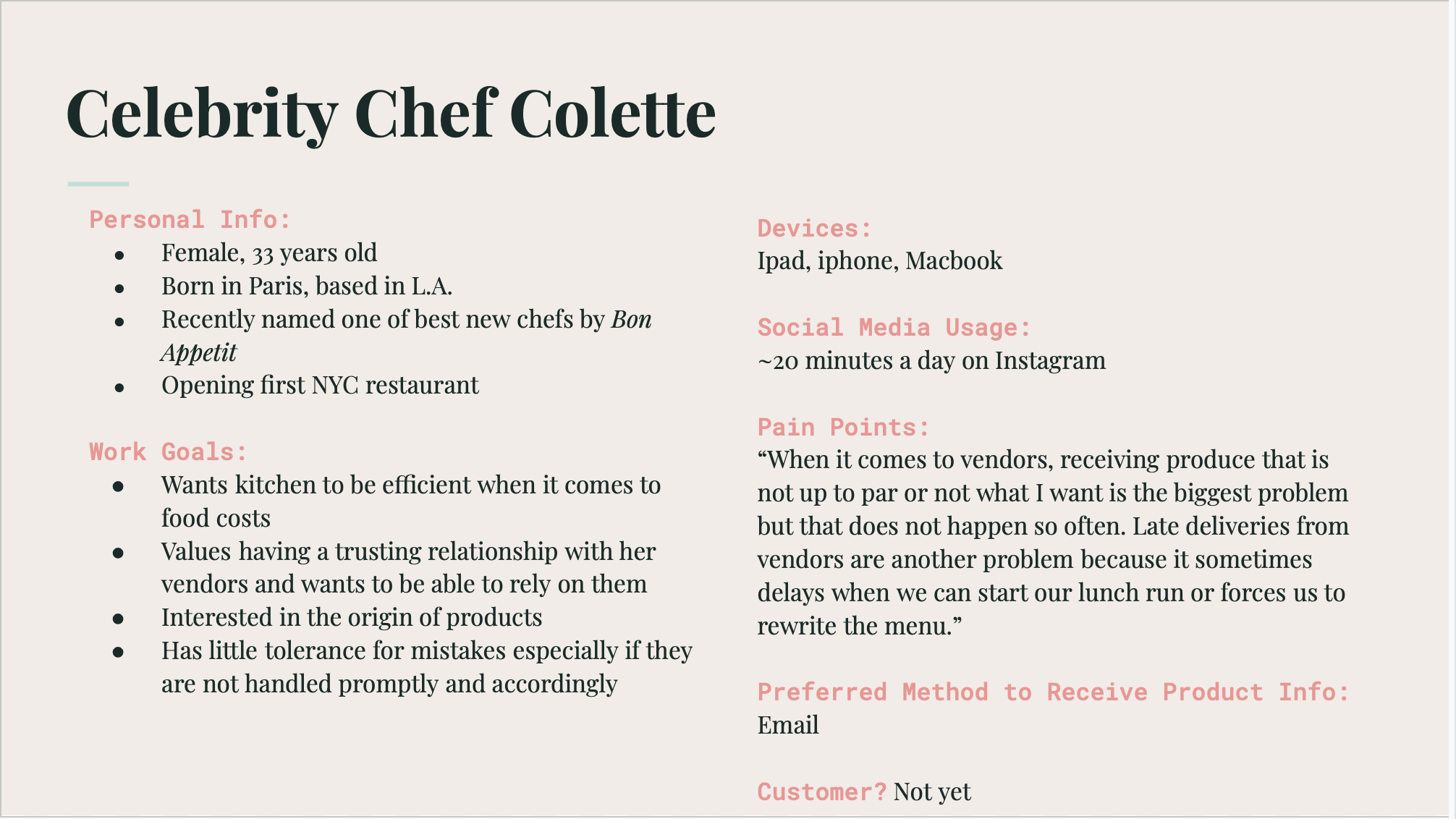
One of four user personas we built in the workshop: Celebrity Chef Colette, who has little patience for late deliveries or a missed order.
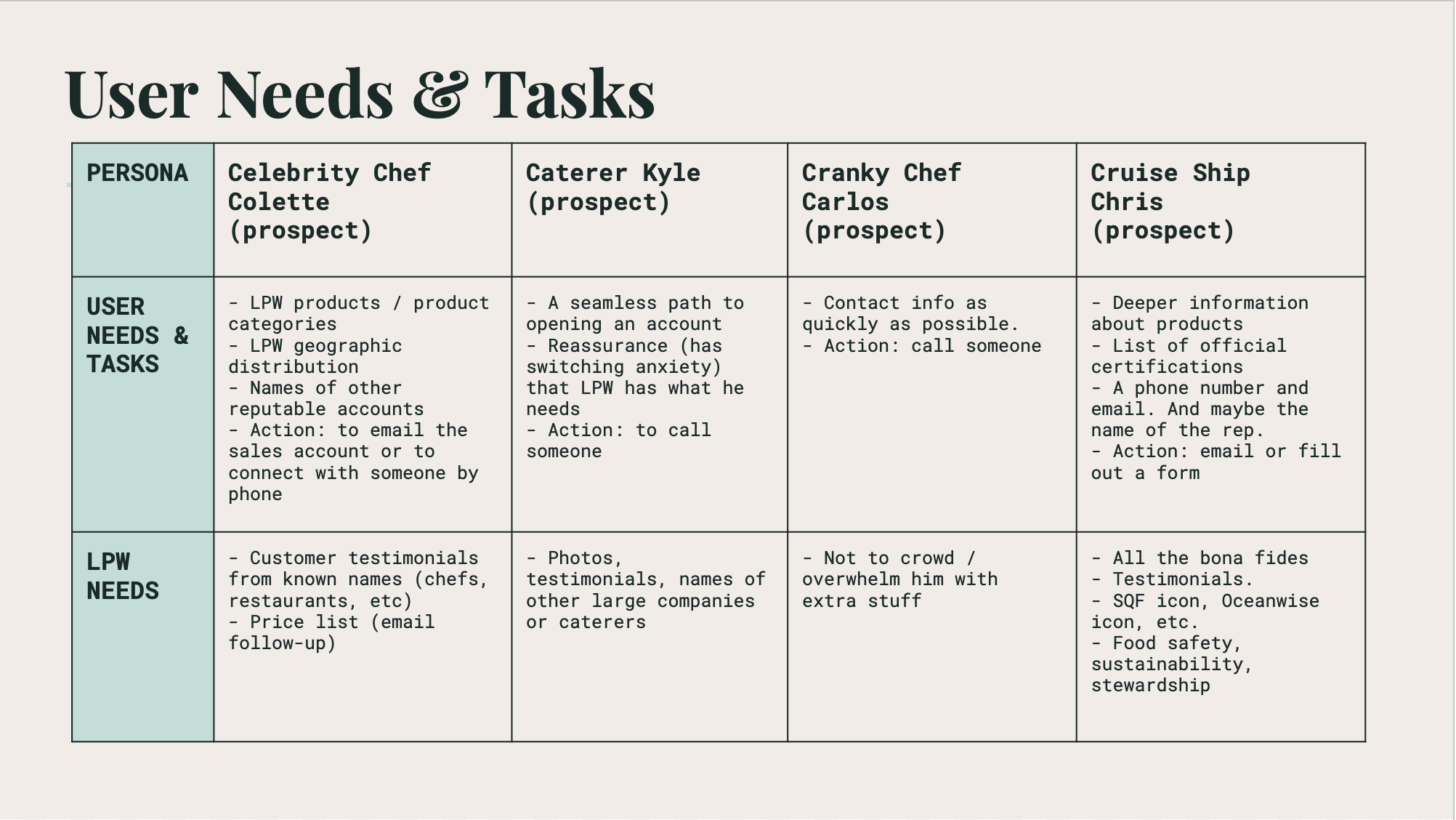
User needs and tasks for four wholesale personas (Celebrity Chef Colette, Caterer Kyle, Cranky Chef Carlos, and Cruise Ship Chris), with what each needs from the site and from The Lobster Place.
Then we looked at the competitive landscape. Wholesale seafood distributors tend to have old-fashioned websites, partly because their clients are old-fashioned too — but we read that as an opportunity rather than a constraint. Across eight competitor sites we found oversized images, little useful information without clicking, and contact details tucked out of the way. Nobody in the category was setting a standard. We pulled it all into a short strategy and recommendations document covering systems, workflow, content priorities, personas and their top tasks, and where The Lobster Place could stand apart.
The job wasn’t to make the site more impressive. It was to make it easier and faster to use.
THE CREATIVE WORKWireframes, new content, and an inventory tool that sorts
We mapped the site, then built wireframes for every page type, writing sample headlines and calls to action right into them so design started from real words instead of placeholder text. A site requirements document covered integrations, analytics, platform, and accessibility, and gave the team a clear brief for choosing a developer.
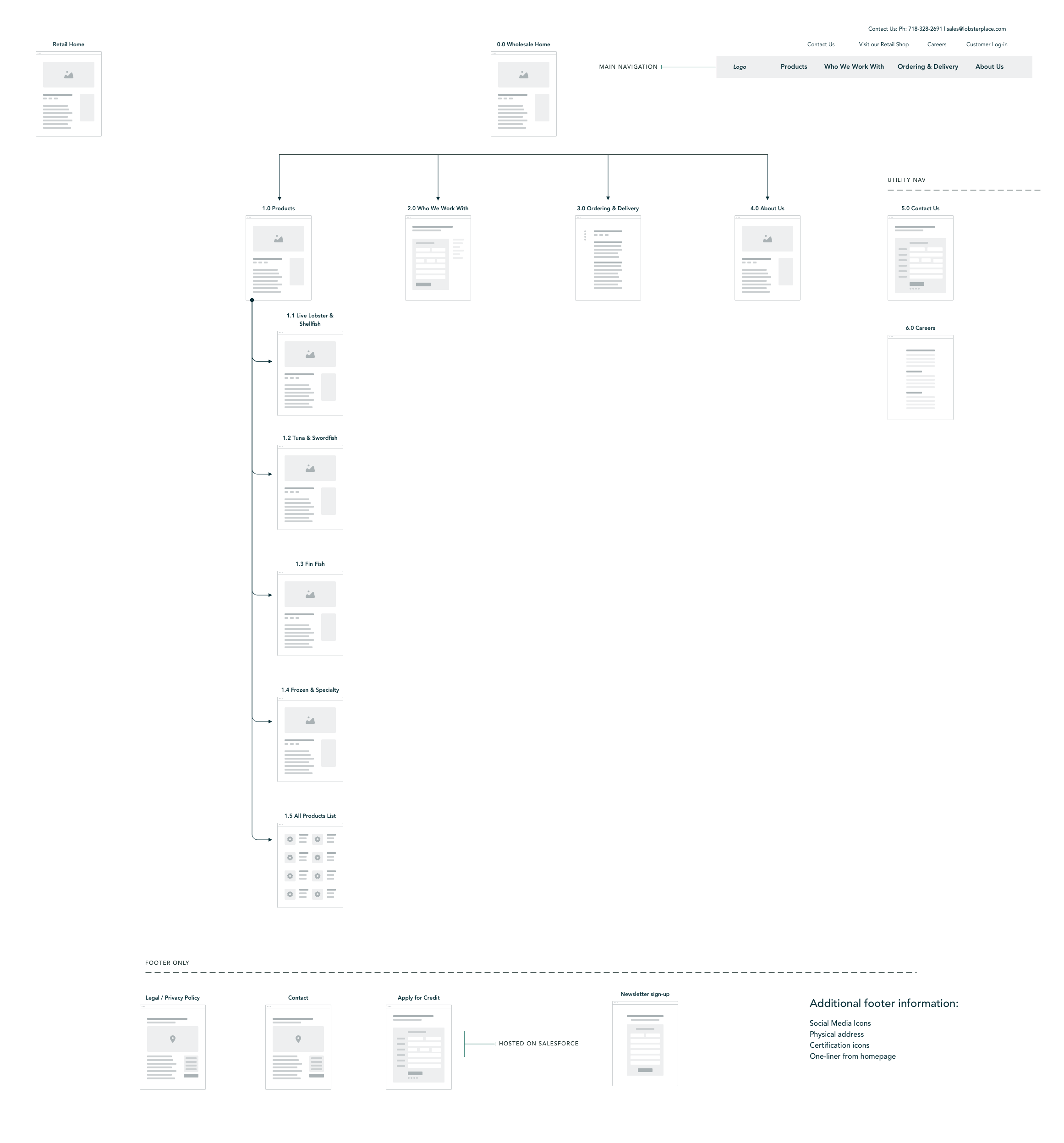
The site map, organized around what a chef or buyer comes to do.
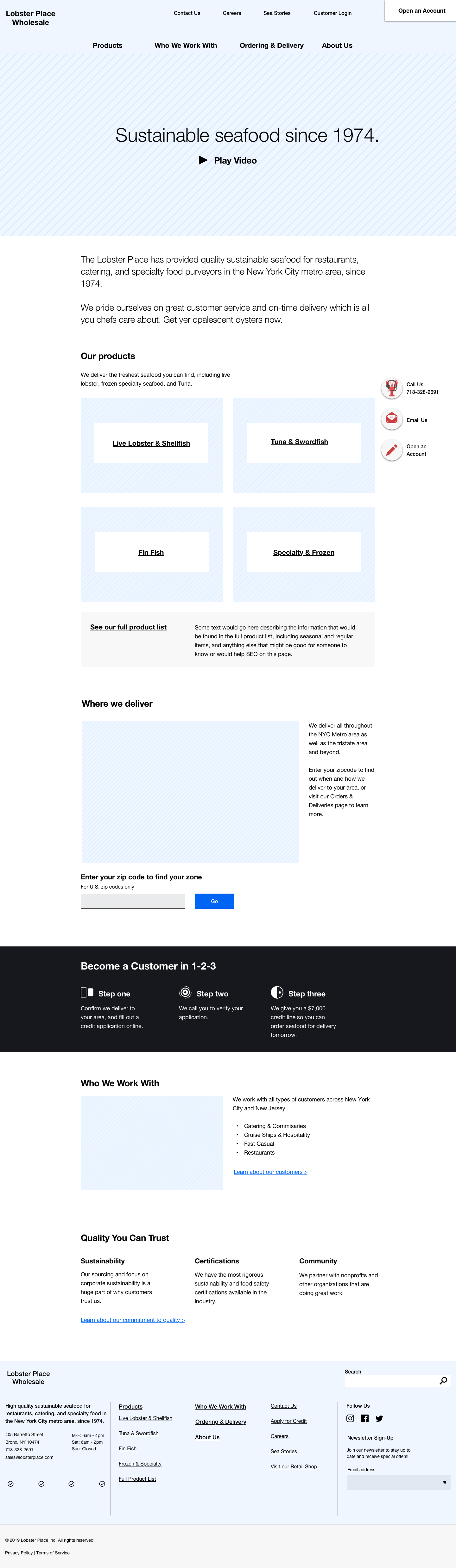
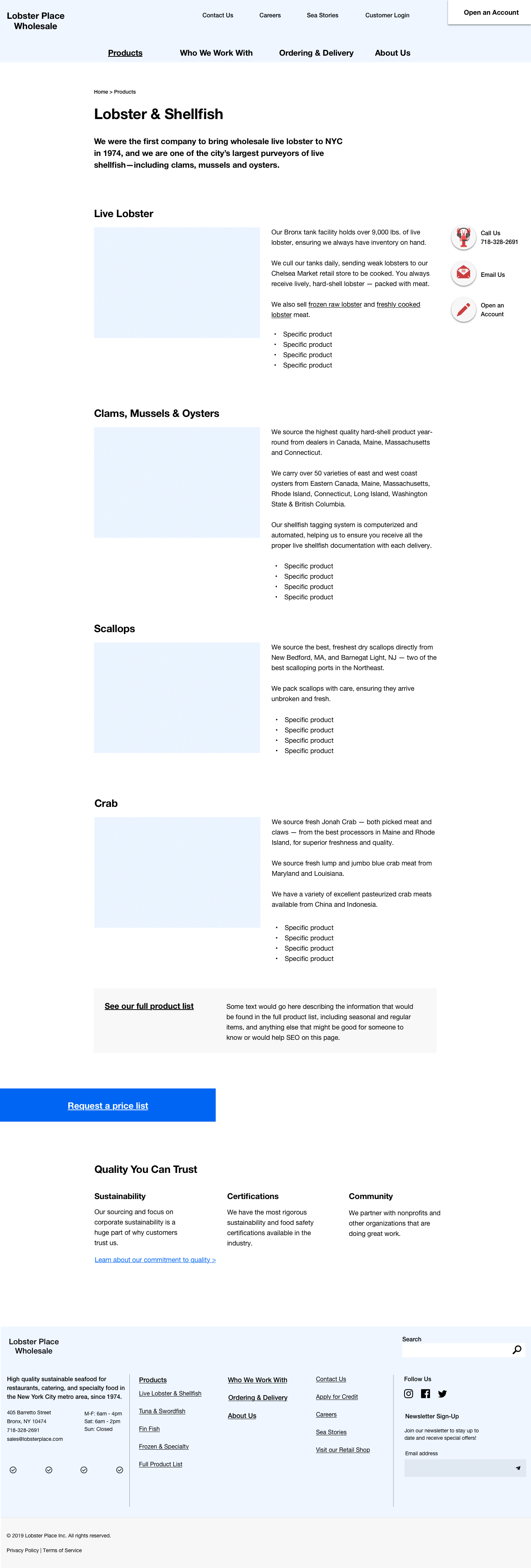
Home and product detail wireframes, with real headlines and calls to action instead of placeholder text.
From there we wrote all the site copy, built around the message the team landed on in the workshop: exceptional seafood, on time, as ordered, to kitchens across New York City, Westchester, and New Jersey, from fine dining to fast-casual and from corporate dining to cruise ships. We coordinated with the developer through the build.
The piece we’re most pleased with is an interactive inventory tool that lets a chef sort and filter by product type and sustainability certification — the kind of feature that sounds small but changes how the whole site feels, because it turns a list you scroll into a question you can ask. The team would have loved to move ordering online, but their customers weren’t going to change how they order, so the tool doesn’t ask them to. It just gets a chef or buyer to the right product faster.
THE OUTCOMEA website that works as hard as the warehouse
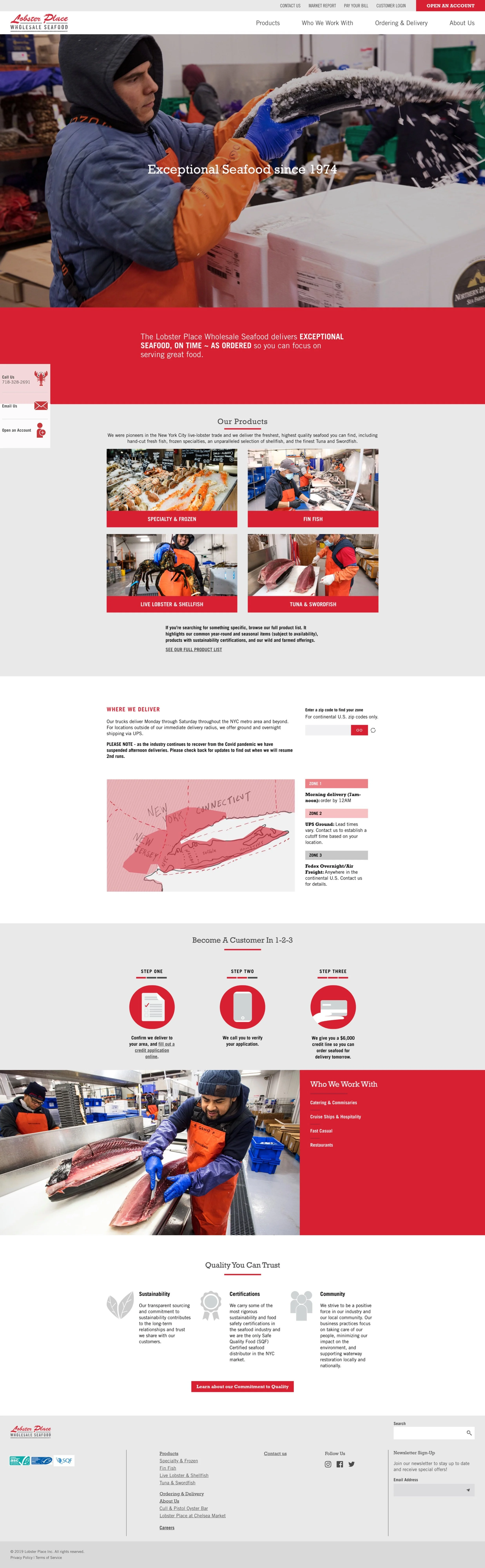
The redesigned Lobster Place Wholesale homepage at launch shows the promise “exceptional seafood, on time, as ordered,” through product categories, a delivery zone map, a three-step guide to becoming a customer, and the commitment to quality, with Lolly the lobster and the call, email, and open-an-account links pinned at left.
The new site led with clear product categories and transparent ordering and delivery details, and it was built for people who know exactly what they want and need to find it quickly. (That’s Lolly the lobster on the left, headset on. She kept the phone number one tap away on every page, since most customers still called in their orders, and gave a site built for getting things done a little personality. )
Most of that clarity came from what we learned before anything was designed. Once we understood who was really arriving — a chef ready to switch suppliers, short on time and with no patience for fluff — the decisions got easier. What went on the homepage, what came first on a phone, what got cut: each one could be measured against what that person needed to do next.
That’s what putting users first looks like in practice. It turned the site into a sales tool built to win new accounts, and it made the same promise online that the warehouse keeps every day: exceptional seafood, on time, as ordered.
Content strategy starts with what your users came to do.
POSTSCRIPTSince then, the wholesale business has grown into LP Seafood and Specialty, a new name for a company that sells far more than lobster—the same problem we ran into in our workshop. The site has been rebuilt along with the brand.
Have a website that isn’t working for the people who use it? Let’s talk.
Prefer email? Send us a note.