
How to Name a Business with Co-Founders
Three Founders, Fifteen Names, One Decision
A naming sprint for three co-founders launching a direct-to-consumer food and wine brand.
A wine bar and an online DTC business are almost nothing alike. In a bar, the space does the talking — the room, the music, the vibe, and a bartender who puts the right bottle in your hand. Online, all of that has to live in the name, the messaging, and the way the thing is built, because there’s no room to walk into and no one there to guide you.
That was the problem three founders brought us: a new business to name, and a startup’s clock to do it on.
LOCATIONNational; HQ in the American South
PROJECT SCOPENaming Sprint
Discovery + Naming Criteria
15 Names Across Five Territories
Facilitated Decision Session
THE OPPORTUNITYA room can’t follow you online; a name has to
Three partners had spent ten years building a wine bar with a devoted following. Their next venture was something else entirely: a direct-to-consumer food-and-wine business built to bring the pantries of Europe — the small producers and regional specialties most Americans can’t easily get their hands on — to tables across the country.
A startup in its own right, not an extension of the bar. They had a decade of hard-won instinct for the first kind of business and were starting the second from scratch. Before a single product photo, before a logo, before a first shipment, they needed a name that could carry the brand where a physical space no longer could.
Ten years in, one of the founders put it this way:
“We have built many things, but one thing I am proud of is we have taught people how to eat and drink like us. It’s thoughtful, and we want our customers to think about what they drink and eat, where it comes from, and make it delicious. There is something to be said about taking this ethos and putting it online.”
That was the thing the name had to carry.
THE CHALLENGEWhy naming with co-founders gets stuck
The three founders didn’t come to us short on ideas. They came with a long list of names they’d brainstormed themselves, most of them built on their existing wine bar’s name. But they hadn’t actually answered the biggest question: should the wine bar’s name come along or not?
Naming for three founders is its own challenge. Each had strong instincts, and on the questions that mattered those instincts landed in different places: whether to carry a thread over from the bar, how hard the new name should lean European, whether the brand should read premium or playful.
They’d also each arrived with a different theory of what a name even is — one pointed to companies whose names meant nothing until the business made them mean something, one to names that read as designed and premium on sight, and one to names that are active, fun, and work as both a noun and a verb. Three reasonable positions. Nobody was wrong, and nobody had a way to choose between them.
There was also a budget reality. A launching startup rarely has the funds for a full brand-strategy engagement, and this one was no exception. The founders had to make a hard call about where to spend first — and they chose naming, because a name was the thing standing between them and everything else they needed to build. So we designed a naming sprint: the rigor of a full process, compressed to what a launching business can actually spend. Framing it that way wasn’t a discount — it was the right first move for where they were.
THE PROCESSFirst, the question: what does this name have to do?
We didn’t start with names, we started with the founders. Each worked through a tailored discovery process independently, before anyone had heard anyone else’s answers. Nobody compared notes, which is exactly what made the results usable.
The first thing those answers showed was how much they already agreed on. Five things, in fact, that none of them knew were settled:
The name shouldn’t tie them to their city or region, because their ambition is national and eventually international.
It should be food-forward, with wine implicit rather than explicit, because food ships to all fifty states and wine doesn’t.
It had to be easy — easy to say, easy to spell, easy to remember after hearing it once, with the dot-com available.
Timeless over trendy, nothing that would date.
It had to welcome the curious newcomer rather than signal exclusivity to people already in the know.
That list became the criteria every name would be measured against — and it carried weight precisely because we hadn’t written it. They had. They were never at odds. They were stuck, which is a different problem and a more common one: three people with good instincts, no shared picture of what they were building toward, and so no way to tell a good option from a merely available one.
Then we mapped where their answers differed, just as plainly, including which difference mattered most. European provenance was the big one: a must-have for one founder, a nice-to-have for another, not important to the third. Whether the bar’s name carried over was the second. We put both in writing, in front of all three, before a single name entered the conversation — because an unsettled question doesn’t settle itself.
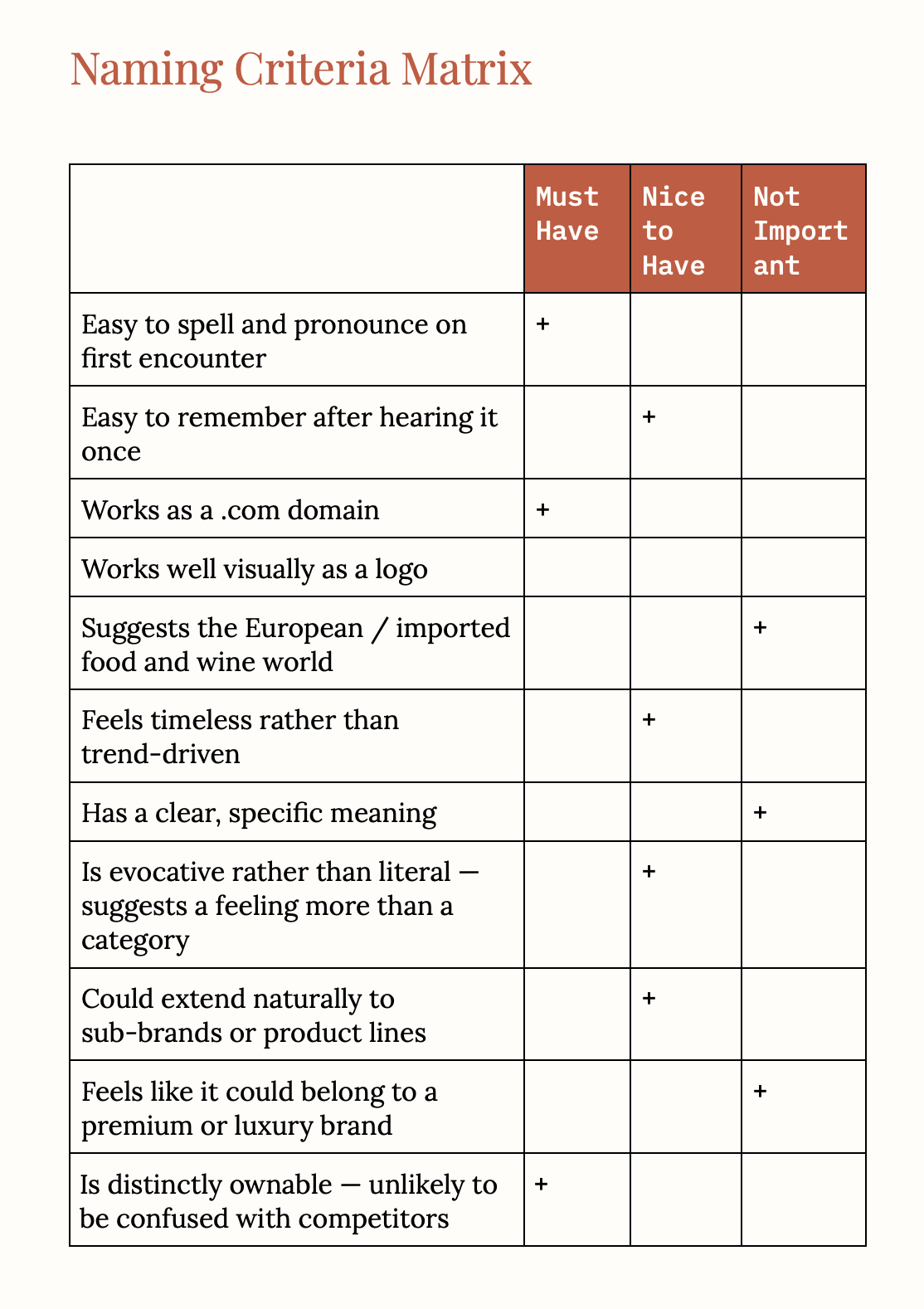
The Naming Criteria Matrix — the criteria a name had to meet, marked Must Have / Nice to Have / Not Important by one of the three founders.
"Megan gave us a process that was rigorous, genuinely fun, and structured so we each felt heard. She pushed our thinking bigger than we could have gone alone."
THE CREATIVE WORKFifteen names, each making a different bet
After the discovery process we developed fifteen names across five strategic territories, each territory a different bet on what the name should do:
a well-stocked place where good things are kept
the occasion the food is for, not the store
the expert whose taste you trust
direct signals of European provenance
a quiet thread back to the founders’ wine bar
We presented every option with sample brand copy and the strategic rationale behind it, so the founders could hear how each would actually sound in the world. We checked the dot-com on all fifteen before they saw any of them, so nothing was off the table before they started.
Before they read a single one, though, we cautioned them that the names they respond to most strongly will be the ones that already have associations built up in their minds — words they’ve heard before, feelings they already carry. That’s not the same as the name being right for this business.
A name is just a word until you build something into it. What fills it — the visual identity, the voice, the product descriptions, the packaging, the emails, the experience of opening a box on your doorstep — is what makes it mean something. Apple has nothing to do with computers. The word arrived with a hundred years of associations, none of them useful, and the company made it mean something else entirely. So the question to hold while reading wasn’t which name feels most finished. It was: does this one give us room to build something into it? Does it create a feeling we could own? Would we be proud to put it on a box?
The right name won’t do all the work. But it will make all the other work easier.
THE DECISIONThe question that actually decided it: what worries you the most?
The founders scored the fifteen and sent comments back. Four names emerged with real support across all three. Then we got in a room.
We opened by taking the vote off the table. The question wasn’t which name wins the most points, or which one do I love. It’s which direction do you actually want to build into — which one gets you most excited to put on a label, on an email, on a website.
Two strategic issues had to be fully settled first: how much the word “food” itself needed to appear in the name, and whether the bar came along. One founder started reaching for a favorite early — “I know we’re not supposed to be talking like that” — and we said, we’ll get there. Both were resolved in that first half hour.
The spectrum did more work than any amount of discussion could have. We mapped every name from most descriptive to most evocative and put it on screen: on the left, the name does the work; on the right, the brand does the work. One founder, looking at it, said simply: “I surprised myself.”
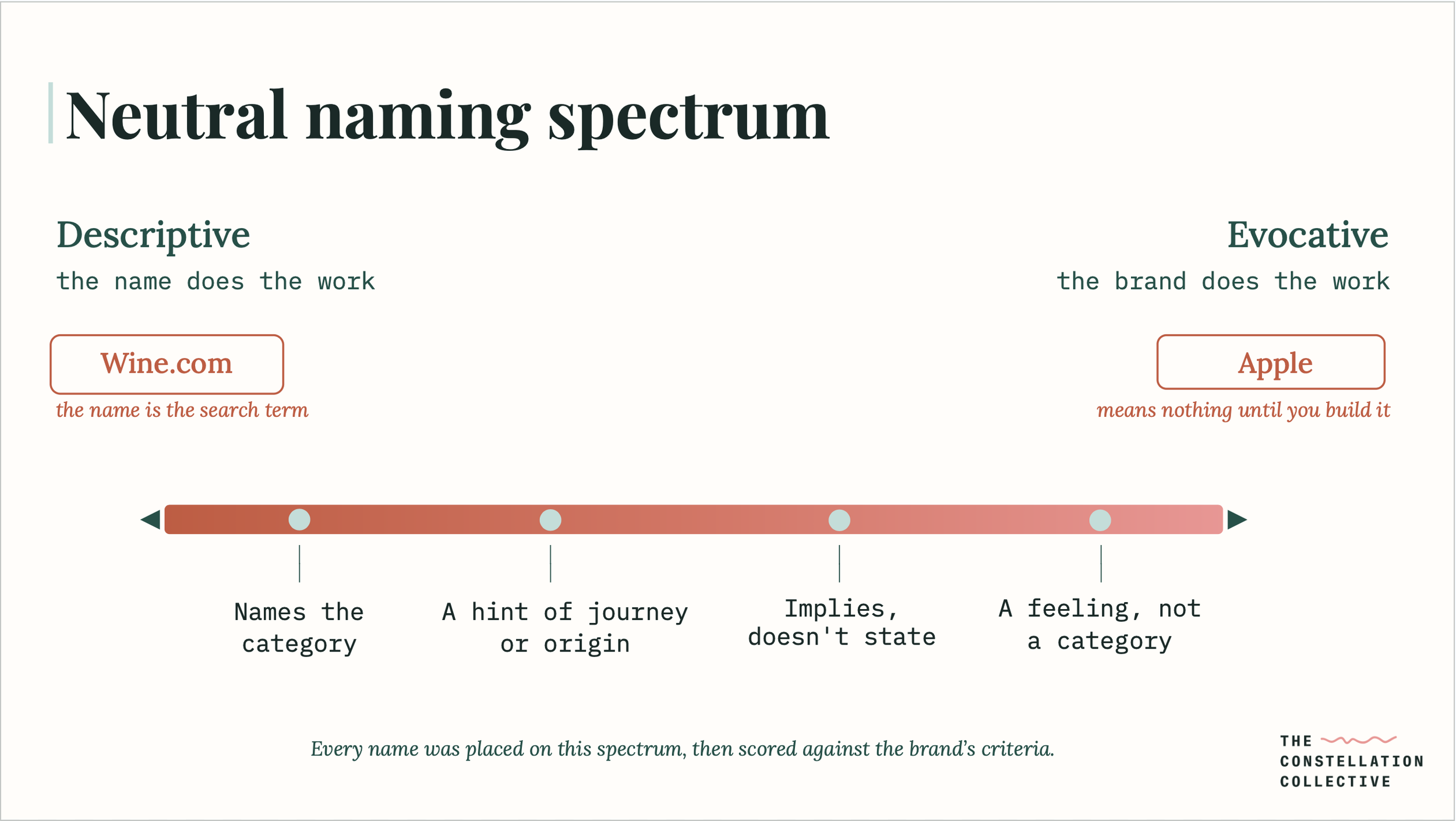
A naming spectrum mapping options from descriptive to evocative (actual names withheld until launch)
Then came the question that decided it. We’d asked what excited them about each of the four. So we inverted it: what worries you the most about this one? That’s when the differences became legible. One name boxed them into a category they’d outgrow, and read as opaque to exactly the curious newcomer they were building for. Another risked sounding like it knew more than the customer. A third pinned the brand to one part of the day, when the products belong to all of it. The fourth carried a single small reservation, about a punctuation mark.
Laid side by side, one name was simply carrying less weight than the others.
What moved in that hour is worth being precise about. The eventual choice was already a favorite of two of the three — but the third hadn’t considered it at all. “It wasn’t even in my view,” he said. “It didn’t pop up to me until really today, listening to everybody talk about it.” Meanwhile a founder who’d ranked it highly the day before had cooled on it by the end of the session — “talking through this, it’s definitely changed position.” One person came toward the name and another moved away from it in the same conversation, and all three still chose it.
The worst outcome is a name nobody objects to and nobody is excited about.
So we didn’t force a decision in the room. They left with homework:
Say each one out loud, write them down.
Type them into a browser and see how they look.
Sleep on it.
Search what already comes up under each name.
Register the domains before someone else does.
That’s the quiet value of a structured process — and the reason it’s worth bringing in someone from outside it. It doesn’t just collect opinions; it changes them, in the open, where everyone can see why. Three partners who couldn’t referee their own conversation because they were in it reached a decision none of them could have reached alone.
THE OUTCOMEA decision, not a compromise
To narrow fifteen names to one, the founders had to answer strategic questions they hadn’t fully faced yet: who this brand is for, what it stands for, what sets it apart from everything else selling food and wine online. The naming sprint forced those questions into the open.
They didn’t walk away with a full brand strategy — that’s a larger body of work, still ahead of them — but they got a vivid preview of why a name, a logo, and a website all depend on it. The brand launches this fall. We’ll add the name here then, along with what it has grown into.
FROM THE CLIENT“As three founders, we all have strong ideas — and usually each of us is the one who has to make an idea happen. Megan gave us a process to channel all of that: rigorous, genuinely fun, and structured so we each felt heard. She pushed our thinking bigger than we’d have gone alone, and brought us to a name we’re all excited to build on. We learned something along the way, and we’d work with her again in a heartbeat.”
— The three co-founders (names withheld until launch)
Naming something with your co-founders? Let’s talk.
Prefer email? Send us a note.